

Bonnard, the "Japanese" Nabi
Lalou Kraffe's work maintains a deep connection with Pierre Bonnard, the Nabi master whose Japanese aesthetics, poetry of everyday life, and decorative intimacy resonate in his delicate and ornamental compositions.
Like Bonnard, she favours filtered light, pervasive patterns and a contemplative gentleness that creates a dialogue between art and domestic life.

privacy
Pierre Bonnard, the painter of intimacy
A student at the Académie Julian, Pierre Bonnard discovered Japanese prints in 1890 and joined the Nabis under the influence of Sérusier . He quickly became the "Japanese Nabi", fascinated by kakemonos, flat compositions and the absence of perspective.
His scenes of domestic intimacy – bathroom, kitchen, garden – place the woman (Marthe, his muse) at the center of a universe bathed in soft light and omnipresent floral motifs.
Colorful vibrations and reflective effects reveal her unique mastery of pure color and changing light.

Japonisme
The influence of Japan
The Ukiyo-e prints of Hokusai and Hiroshige profoundly influenced Bonnard. He adopted their bold framing, off-center figures, and significant voids that structure the space.
The canvas becomes a decorative surface where floral patterns, textures and colors create a continuous rhythm, like a Japanese decorative wall.
Marthe, draped in kimonos and floral fabrics, embodies this sublime Japanese woman in settings inspired by shojis and oriental screens.

intimacy of nudity
The intimacy of everyday life
Bonnard revolutionized the nude by placing it in domestic intimacy: Marthe in the bathroom, the bedroom or the garden, captured in suspended moments.
More than 400 paintings celebrate these moments of daily grace where every gesture becomes a meditative ritual.
Delicate pastels, flesh tones and water reflections convey a chaste sensuality, while steam and fine fabrics envelop these scenes in an atmosphere of time standing still.
colorful optimism
Color, light and vibration
Bonnard painted outdoors to capture the light vibrations, then recreated his memories in the studio.
His personal pointillism technique juxtaposes pure and complementary colors, creating relief through contrast rather than modeling.
Translucent fabrics, diaphanous skins and water vapors reveal her mastery of layering.
Its joyful palette – sunny yellows, soft pinks, spring greens – celebrates chromatic optimism in perfect harmony.

total art
Bonnard and decorative art
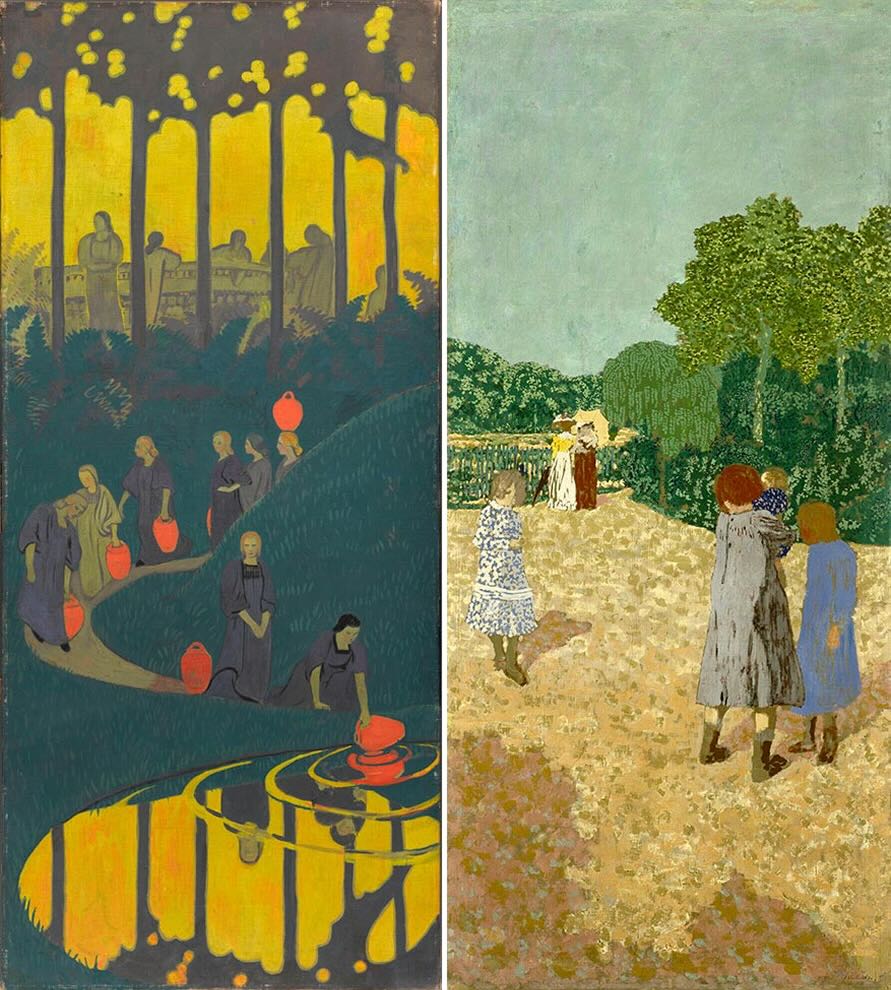
A master of total art, Bonnard excelled in screens and decorative panels for bourgeois interiors.
His posters for France-Champagne and book illustrations demonstrate his graphic mastery.
Vases, rugs and fabrics are naturally integrated into his compositions, abolishing the boundary between fine art and applied art.
His paintings function like wall panels, designed to poetically inhabit domestic spaces.

Bonnardian intimacy
Lalou Kraffe, contemporary heiress
Like Bonnard, Lalou favoured the softness of feminine interiors, filtered light and omnipresent textile patterns.
His tea drinkers, dreamers in the garden or women in contemplation, are reminiscent of Bonnard's intimacy.
His modern Japonisme – clean lines, absence of perspective – extends the ukiyo-e legacy.
Wooden panels enhanced with metallic leaves and ornamental compositions make her the contemporary heir to this total art where painting and craftsmanship engage in dialogue.

forever
Why Bonnard still moves us
Bonnard's eternal modernity lies in his ability to capture the universal intimacy.
Her vibrant palette offers an antidote to gloom, while Marthe embodies a modest and dreamy femininity.
It invites us to rediscover the beauty of simple gestures and to inhabit our interiors poetically.
Its refined Japonisme reminds us that simplicity, harmony and emptiness create the most beautiful setting for emotion.
User Name 2 Days ago
Lorem ipsum dolor sit amet, consectetuer adipiscing elit. Aenean commodo ligula eget dolor.